

We all know people in our lives who’d make great characters in a film or a novel.
Maybe it's a friend who tells a different story about how he got that lucrative job (even though you never asked). Or your wife's uncle who has a perfect “she’r” (couplet) for every situation. Or your grandmother who survived a bloody war but never wants to talk about it.
As a writer, these character-worthy people spark my imagination.
When I meet people like these, I find myself wanting to understand them more deeply.
I’m curious about everything. Why do they do what they do? What’s shaped them? What are their fears? Their desires? Motivations?
Of course, I never ask these questions directly. That would be intrusive, and people rarely have accurate insights into their own psychology anyway.
Instead, I look for clues in their patterns of behavior, their unique mannerisms, the recurring themes in their conversations, and especially the stories they choose to share. Or omit.
Later on, I might “borrow” some of the traits from these people.
The friend who tells different versions of his success story might inspire a protagonist with impostor syndrome, constantly reinventing himself to meet others' expectations.
The poetic uncle could transform into a character who uses literary references to keep people at a distance and avoid sharing vulnerabilities.
The silent grandmother might evolve into a character whose present actions are secretly driven by unspoken past trauma.
(To my friends reading this, please know I'm genuinely interested in our conversations. But I can't promise your unique quirk won't someday appear in one of my stories.)
Using Psychology to Write Memorable Characters

This was just a glimpse into how some writers might observe people. We’ll take a deeper dive into the psychological principles that can help you create authentic characters.
But before we go any further, let me clarify what I won't be doing: I won't be reducing characters to neat personality categories or labeling them as simply introverted or extroverted, open or guarded.
Real people don't fit into tidy boxes—they behave in contradictory ways, act differently across situations, and often surprise themselves with their own choices. The same should be true for our characters.
Instead, we'll explore how understanding psychological patterns can help us create characters who feel as wonderfully complex and unpredictable as the people who inspire them.
The Childhood Blueprint: Why Psychologists (and Writers) Look to the Past
“Tell me about your childhood…”
If you’ve ever been to therapy, you've probably been asked this question within the first few sessions.
There's a reason for this persistent focus on parents and early experiences—they establish patterns that tend to echo throughout our adult lives.
As writers, understanding this childhood blueprint gives us powerful insights into character development. Why does your protagonist avoid conflict at all costs? Perhaps they grew up in a household where disagreements escalated into chaos.
Why does your antagonist need to control everything? Maybe their early world was unpredictable and frightening.
The beauty of this approach isn't just in explaining behaviors, but in creating realistic complexity. Two characters with similar difficult childhoods might develop completely different coping mechanisms.
One becomes a people-pleaser, desperate for approval; another builds impenetrable walls against potential rejection.
Same cause, different manifestations—just like in real life.
When you explore a character's formative years, you're not looking for simple cause-and-effect relationships. You're uncovering the internal beliefs they formed about themselves, others, and the world.
"I am unworthy of love."
"People will hurt me if I show weakness."
"The world rewards only the perfect."
These core beliefs drive behaviors in ways your character may not even recognize.
As a writer, you don't need to explicitly include childhood flashbacks or lengthy backstories. But knowing these foundational experiences helps you create consistent, authentic reactions when your character faces challenges or opportunities.
When a seemingly confident character inexplicably sabotages their own success, readers won't feel manipulated by plot convenience—they'll sense the deeper psychological truth at work.
The Character Psychology Triangle: Desires, Fears, and Contradictions
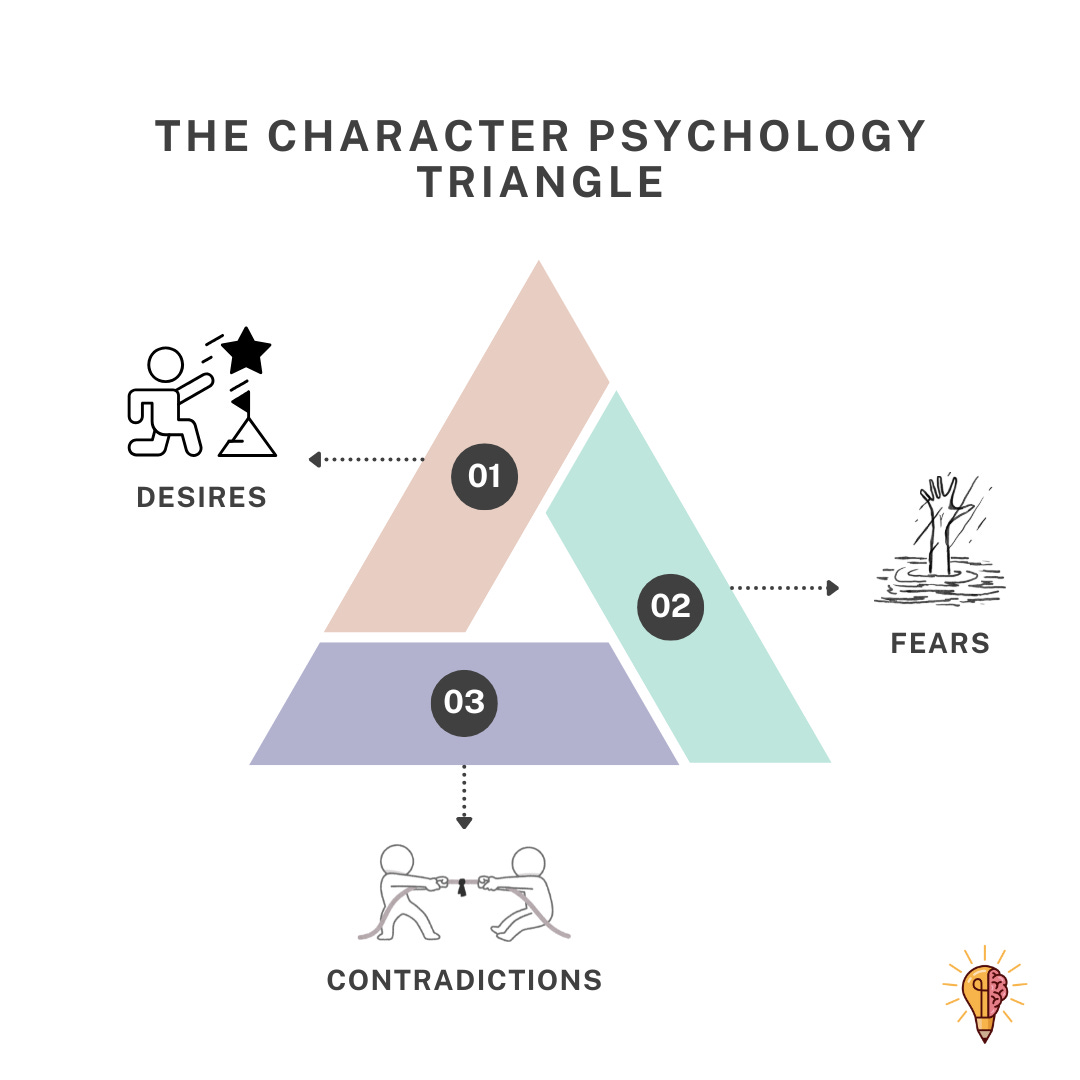
Understanding a character's childhood gives us valuable insights, but to create truly memorable characters, we need to focus on three psychological elements that drive human behavior: desires, fears, and contradictions.
Desires are what your character wants—consciously or unconsciously. Is it recognition? Safety? Power? Connection? These deep-seated wants drive their decisions. Don Draper in "Mad Men" craves belonging and legitimacy, constantly reinventing himself to escape his impoverished past.
Fears represent what your character is desperately trying to avoid. Behind many desires lurks a corresponding fear. Severus Snape in the "Harry Potter" series fears vulnerability and emotional exposure, masking his enduring love for Lily with coldness and cynicism.
But it's the contradictions that truly bring characters to life. Humans are walking bundles of inconsistencies. In "Succession," Kendall Roy desperately seeks his father's approval while simultaneously trying to destroy him. These contradictions create tension that the audience recognizes as authentic.
The most memorable characters exist in this triangle of competing forces. Daenerys Targaryen in "Game of Thrones" desires to be a just ruler while fearing she'll become like her father, yet contradicts her liberator identity by eventually embracing destruction.
Creating Authentic Character Flaws
Perfect characters are perfectly forgettable.
It's the flaws that make characters stick in our minds long after we've finished the book or left the theater.
But not all character flaws are created equal.
The most psychologically authentic flaws aren't random quirks or habits—they're intrinsically connected to a character's strengths, desires, and psychological makeup.
Consider Sherlock Holmes. His brilliant analytical mind—his greatest strength—directly connects to his most compelling flaws: his arrogance, impatience with others, and difficulty with normal human connection.
These aren't separate traits tacked on to make him "more interesting." They're the natural shadow side of his gifts.
Psychologically realistic flaws typically fall into three categories:
The flip side of strength: Courage becomes recklessness. Ambition becomes ruthlessness. Persistence becomes stubbornness. In "Breaking Bad," Walter White's intelligence and resourcefulness—initially positive traits—become corrupted into manipulation and callousness.
Protection against fear: A character afraid of rejection might develop the flaw of people-pleasing or, conversely, preemptive rejection of others. In "The Social Network," Mark Zuckerberg's fear of social rejection manifests as a flaw of intellectual arrogance and dismissiveness.
Overcompensation for perceived inadequacy: Batman's obsessive crime-fighting stems from his inability to save his parents, driving him to extreme measures to prevent others from experiencing similar loss.
The most compelling flaws create both internal and external conflict.
Internally, they put the character at war with themselves. Externally, they create friction with others and obstacles to achieving goals.
Character Arcs and Psychological Growth
Real people don't change overnight, and neither should your characters.
Psychological growth is rarely a straight line—it's messy, inconsistent, and often involves backsliding into old patterns before true change occurs.
The most realistic character arcs acknowledge this psychological truth. They show characters taking two steps forward and one step back, struggling against their own deeply ingrained patterns even as they try to evolve beyond them.
Consider Michael Scott in "The Office." His journey from an insecure, inappropriate boss to a more self-aware and mature person isn't linear. He repeatedly falls back into seeking validation through humor and attention when faced with stress or insecurity.
This back-and-forth between growth and regression feels authentic because it mirrors how real psychological change happens.
The key to writing believable character growth is understanding that people resist change, even positive change.
Our psychological patterns, no matter how dysfunctional, feel safe because they're familiar. In "Groundhog Day," Phil Connors initially doubles down on his narcissistic behavior when trapped in the time loop, finding change more threatening than repetition, before gradually embracing personal growth.
When writing your character's psychological growth, don't rush it. Show the backsliding, the resistance, the moments of falling back on old defense mechanisms when stressed.
Let your character make progress and then sabotage themselves when things get uncomfortable.
The most satisfying character arcs aren't about complete transformation—they're about characters gaining insight into their own patterns and making incremental shifts that eventually lead to meaningful change.
Putting Theory into Practice: Character Development Exercises
The best way to internalize these psychological principles is to apply them.
Here are some writing prompts designed to help you explore your characters' psychological depths:
The Revealing Stress Test: Write a scene where your character faces their deepest fear. Focus not on external action but on their psychological reaction—what defense mechanisms emerge? What childhood patterns resurface?
The Mirror Character: Create a character who shares your protagonist's core wound but developed an opposite coping mechanism. Write a scene where these two characters conflict, each triggered by recognizing their own issues in the other.
The Contradiction Exploration: Write a scene revealing the gap between what your character says they value and how they actually behave. Show their self-justification for this inconsistency.
The Growth Moment: Write a scene where your character has an insight into one of their destructive patterns. Then write the next scene where, despite this awareness, they fall back into the pattern when under stress.
Wrapping Up
I hope you found this edition valuable. To help you apply these concepts to your writing, I've created a Character Psychology Worksheet. It will guide you in developing your characters' psychological profiles, from their childhood experiences to their present-day contradictions.
You can use it as a foundation to create more authentic, multi-dimensional characters.
[Character Psychology Worksheet - Please create a copy of this and then make any changes you want].
Have a great day! :)
This is a solid way of showing that character depth comes from pattern, not labels. Linking childhood beliefs to present contradictions explains behavior without flattening it into backstory exposition. I especially like the emphasis on flaws as extensions of strengths rather than decorative damage. The triangle of desire, fear, and contradiction gives writers a usable structure that still leaves room for messiness and surprise.
This is a great strategy. Using the antithesis character was something new I haven't learned before. Try acting out your characters. Actors use this very similar process (shocker, I know).