

To the world, she was a nanny.
With children in tow and a camera hanging around her neck, she quietly photographed the streets around her – strangers, children, street corners, shadows, the small ordinary moments of city life.
It was years later, by chance, that these photographs were discovered. And when they were, the photography world was stunned. The nanny, it turned out, had been taking some of the finest street photographs of the twentieth century.
Her name was Vivian Maier.
Over her lifetime, she took nearly 150,000 photographs, but never shared any of it with the world while she was alive.
To many, Maier represents a romantic ideal of the pure artist. Creating for the love of it alone, with no need for applause or validation.
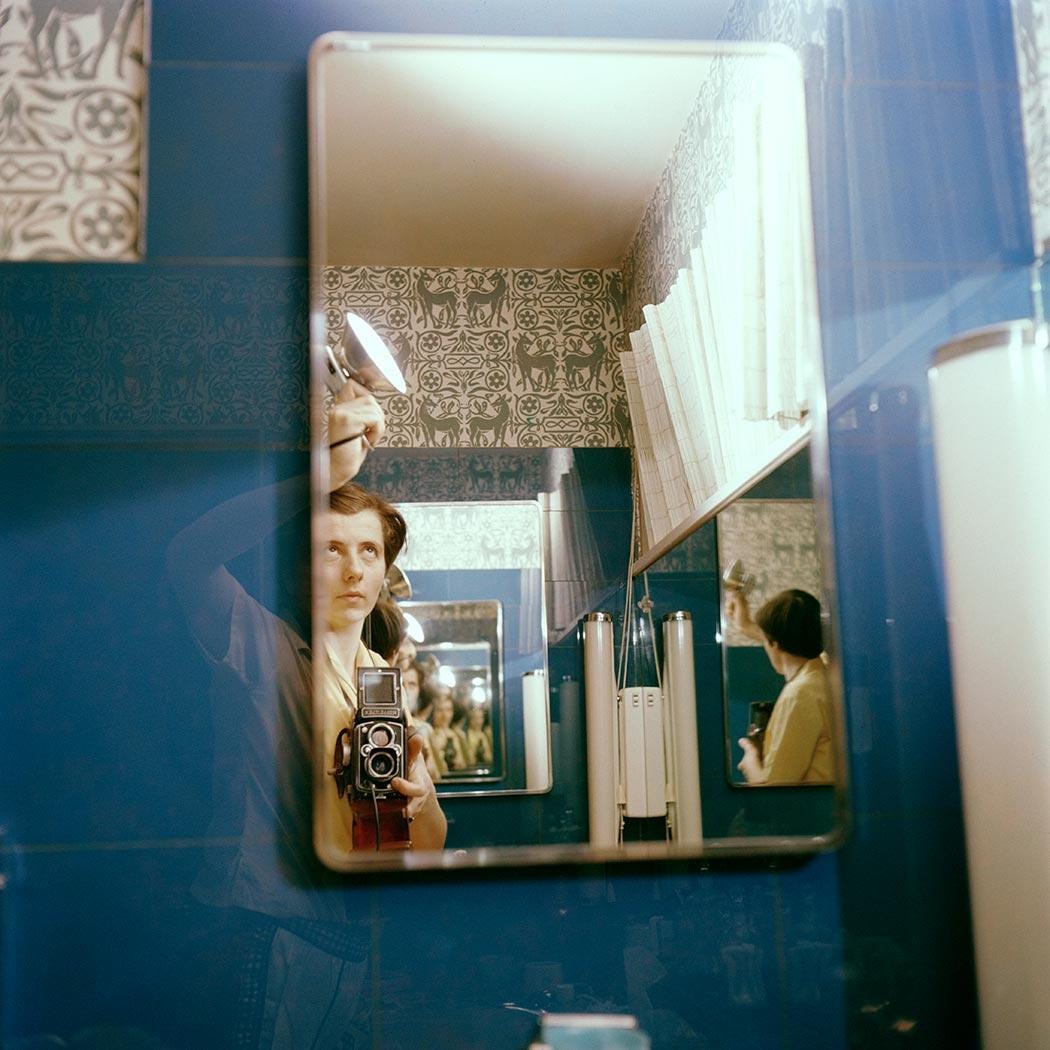
Photo: Vivian Maier/Maloof Collection
We don’t actually know why she never shared her work. Maybe she wanted to and couldn’t. Maybe circumstances, money, or the practical barriers of being a working woman with no connections to the art world got in the way.
Charlie Siskel, co-director of Finding Vivian Maier, believed that her obscurity was probably more ‘an accident of history than something she did by design’.
Not everyone agrees. Many who knew her remember a deeply private woman, guarded and reclusive, who seemed to have little interest in being known by the world.
Whatever the reason, her work existed in isolation, untouched by audience, reaction, or feedback of any kind.
—
Would you still write if nobody ever saw or read your work?
I have asked myself this question many times.
The honest answer is complicated. Writing comes naturally to me and does something for me that has nothing to do with an audience. It’s a way for me to process my feelings, make sense of my relationships, and quiet a constantly restless mind. So yes, in that sense, it has an inherent value.
But that’s only half of it. I’d be lying if I said I didn’t need it to be read. Writing for me is also a way to connect. To reach toward another person and say hey, here’s what I think is true or here’s something I feel deeply. Do you recognize it? Do you feel it too? This interaction with the reader is what makes writing meaningful to me.
Connection isn’t the only reason I put my work out there. Publishing also creates a feedback loop that private writing simply cannot replicate.
The essayist Henrik Karlsson recently wrote a brilliant essay where he broke down the craft of writing into its simplest parts.
First, there is the mind. The quality of your thinking determines the quality of your writing.
Then there is input. To improve your mind, you feed it. Books, conversations with interesting people, new experiences, new skills. Everything that improves your mind, and in turn, your writing.
And finally there is output. What you actually put out into the world. The better your mind and input, the better your output.
It is only when you share your output that the feedback loop begins. Your readers’ reaction, or their silence, is always telling you something. Maybe the piece didn’t resonate. Maybe you haven’t found the right topic yet. Maybe you’re sharing in the wrong place. Whatever it is, it’s useful.
You go back, seek better input, improve your thinking, and the next output is better than the last. The more you share your work, the faster the loop turns.
—
What if Maier’s work was extraordinary precisely because nobody saw it? What if having an audience, with all their opinions, preferences, and reactions, would have compromised it? What if the purity of her work came from the fact that she was completely untouched by what anyone thought?
She had no feedback loop or any pressure to get likes, shares, and subscribes. Just her and the streets and the camera.
Here lies the paradox*: the only way to truly connect with a reader is to stop thinking about the reader while you write. The work has to come from within—personal, honest, authentic, uninfluenced. And then, only then, does it have a chance of meaning something to someone.
The lesson from Maier’s story, perhaps, is to create the way she did. Purely, honestly, for the love of it. But then have the courage to share it.
The gift of connecting with another person, of having something you created mean something to someone, is simply too precious to keep to yourself.
Whether that was a loss for Maier, we can’t say. But for most of us, it would be.
—
*William Zinsser wrote about this paradox in his 1976 book On Writing Well.
Fabulous article about this "Nanny".
As for writing purely for myself... Absolutely. Is it not what we do until we dare to show and or publish our work?
I do that currently. I have a blog and now a Substack. There is only one person I know of so far who says they have read anything I have written.